THREAD LIFTING
Fox Eye / Cat Eye Thread Lift
The fox eye / cat eye thread lift is a name used on social media. It describes using threads to support the tail of the brow and the tissue around the outer corner of the eye in the direction of the temple. It does not change the eyelid or the bone structure; the change reported in studies is measured in millimetres and is not permanent.
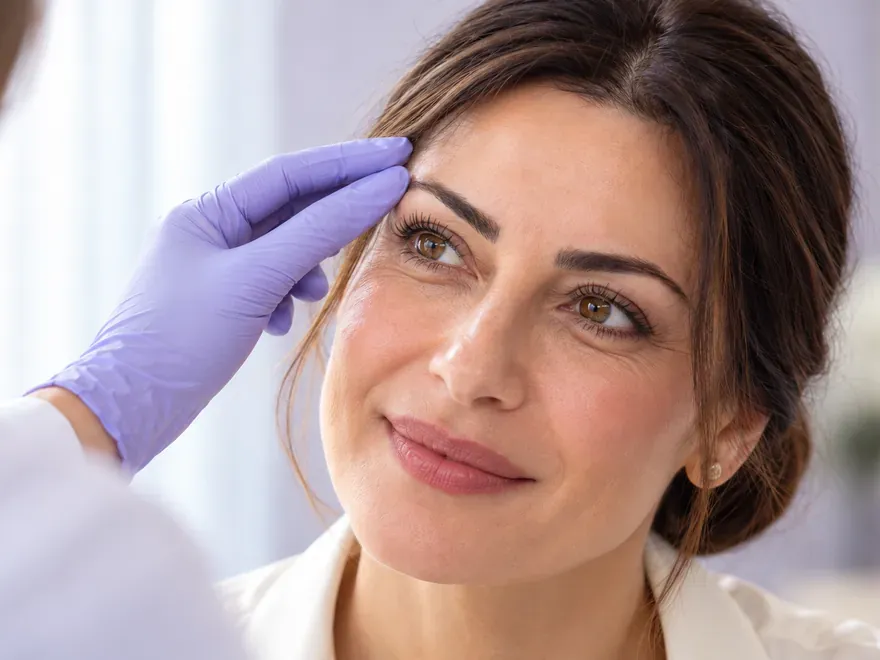
- TREATMENT GROUP
- Thread Lifting
- TREATMENT AREAS
- Tail of the browOuter corner of the eye
- SCIENTIFIC REFERENCES
- 24 publications
APPOINTMENTS
Let’s talk at a consultation about whether Fox Eye / Cat Eye Thread Lift is right for you, what it involves and its possible risks.
Call usMessage us on WhatsApp+90 530 925 24 78
AT A GLANCE
At this clinic
- Product type
- Absorbable medical threads (PDO / PLLA, etc.)
- Sessions
- Usually 1 session
- Treatment time
- About 30–45 minutes
- How long it lasts
- Varies with the threads used, the treated area and individual factors; on average 3–4 years
- Anaesthetic
- Local anaesthetic
- Follow-up
- Usually after 2–4 weeks
The type of thread, the number of threads and the technique vary with the area treated.
What is a Fox Eye / Cat Eye Thread Lift?
The fox eye / cat eye thread lift is a lifting treatment that uses threads to support the outer end of the eyebrow and the tissue around the outer corner of the eye in the direction of the temple. In the medical literature, there is no single procedure that corresponds to this name; this area is covered under the headings of brow lifting, drooping of the outer corner of the eye (lateral canthal ptosis) and skin hooding at the temple.
In the techniques used for this area, barbed or knotted threads are passed under the skin at the temple and anchored to firmer tissue within the scalp. In one study, the threads were passed with a blunt-tipped cannula (a fine tube without a sharp point) through the loose layer beneath the superficial fascia of the temple. The anchoring part of the thread was fixed beyond the bony line of the temple, to the firm layer of connective tissue under the scalp (the aponeurosis). In another study, the threads were extended as far as the fascia of the scalp to spread the load across more than one firm structure.
The thread holds up the tissue mechanically as soon as it is placed, so part of the change is visible during the procedure. According to a publication based on clinical cases, lifting the brow with threads gives a more limited change than surgery and needs to be repeated at intervals. The treatment does not act on the eyelid, the eyelid muscles or the bone.
RELATEDFrench Thread Lift
Where does the name come from?
‘Fox eyes’ and ‘cat eyes’ are English names that have become popular on social media; they are not the names of a medical procedure or technique. They describe a look in which the outer corner of the eye and the tail of the brow extend upwards and outwards. Because the same name can be used both for thread treatments and for surgical procedures on the corner of the eye, the name alone does not show which procedure is meant.
Research has also questioned the quality of this kind of content. In a study that reviewed 173 videos about cosmetic surgery on the corner of the eye (canthoplasty), quality and reliability scores were mostly low. Healthcare professionals had uploaded 82.1% of the videos, and 46.2% focused on promotion rather than on providing scientific or educational information. Another study, which looked at social media posts about eyelid surgery, found that the prominent themes included dissatisfaction despite an acceptable result and distress caused by mild asymmetry. According to the researchers, people mostly judge success by how they look in photographs.
The shape of the area around the eyes naturally varies from person to person and with sex and ethnic background. A study that showed this with three-dimensional measurements stresses that these differences should be taken into account in planning. For this reason, no eye shape is treated as a standard or a target; a thread lift is discussed to address what your doctor finds at the examination, not to copy a look.
When is it considered?
- The outer end of the eyebrow (the tail of the brow) dropping with age.
- The outer corner of the eye appearing to slope downwards (medically known as lateral canthal ptosis).
- Skin hooding over the outer corner of the eye because of laxity at the temple.
- A heavy look to the upper eyelid caused by drooping brows.
- Changes in the shape of the brow with age.
- This list shows when the treatment may be considered; whether it is suitable for you is assessed at a consultation.
Why does the tail of the brow drop?
With age, the tissue of the forehead and brows moves downwards under the effect of gravity. This can show up as a heavy look to the upper eyelid. According to research, many people who seek cosmetic eyelid surgery also have drooping brows, so the brows and forehead need to be assessed separately. There is often little subcutaneous fat (the fat layer under the skin) in the forehead, which means that working with threads in this area depends on a good knowledge of anatomy.
The brow does not move as a single unit. In most studies of surgical brow lifts, the inner end of the brow rose the least and the outer end rose the most. In these studies, the lift decreased markedly over the long term, and the gain proved especially hard to maintain in the outer part of the brow. Although these findings relate to surgical methods, they help explain why the lift achieved at the tail of the brow is not permanent.
It is not only the height of the brow that changes with age but also its shape. In a retrospective series (based on past records) of 29 patients who had a thread brow lift, the researchers note that lifting the whole brow does not always lead to satisfaction, and they recommend also taking the angle of the inner end of the brow into account. So the issue is more detailed than simply saying ‘my brow is low’: at the consultation, your doctor assesses separately which part of the brow has changed, by how much and in which direction.
RELATEDBrow Thread Lift
The outer corner of the eye and the temples
The position of the outer corner of the eye and the tail of the brow is closely linked to the tissue of the temple. According to a study that examined this, the temple area helps hold the outer corner of the eye and the brow in place. The superficial fascia of the temple and the connective tissue under the scalp weaken with age. This weakening contributes to skin hooding over the outer corner of the eye and to the corner of the eye appearing to slope downwards.
This is why a thread lift in this area does not touch the corner of the eye directly. By moving the soft tissue of the temple upwards and outwards, it supports the outer corner of the eye and the tail of the brow indirectly. In one technical study, dissolvable (absorbable) barbed threads were used together with knots to lift the outer edge of the brow and the eye. The knots were buried under the skin, and the threads were extended as far as the fascia of the scalp, spreading the load across more than one firm structure.
There is an important distinction here: the thread does not act on the eyelid’s own supporting structures or on the bone structure; what it addresses is laxity in the temple tissue. A finding that comes from the eyelid or the bone structure is outside the scope of a thread lift and is assessed separately. The eye shape you were born with, on the other hand, is not a problem or a finding, and it is not what this treatment is for.
What does the research report?
The short answer: very little. The published data specific to this area come from small case series with no control group. No comparative studies or randomised trials (trials in which participants are randomly assigned to groups) were found. The figures in these series are measurements taken only in those patients; they are not the expected result for anyone.
The most detailed measurements for the outer corner of the eye and the temple come from a retrospective series of 22 Asian women. In this series, the angle of the outer corner of the eye rose from an average of 2.1 degrees to 4.3 degrees at 6 months after the procedure, then fell to 3.6 degrees at 12 months. The increase in the height of the tail of the brow was measured at an average of 2.4 mm at 6 months and 1.8 mm at 12 months. Side effects were reported to be mild and temporary. The researchers classify their study as level V evidence (an uncontrolled series) and state that comparative, prospective studies are needed to establish how long the results last.
In a technical study that lifted the outer edge of the brow and eye with knotted threads, 34 patients were followed up for at least six months. However, the result was measured by the patients’ own assessment, and the data were reported by the team that developed the technique. In a brow series of 29 patients, follow-up lasted 3 months; 26 patients said they were satisfied or very satisfied, and no serious complications were seen. In another series of 15 patients, the brows measured lower than before the procedure in the first week; at 12 weeks, both the brow and the upper eyelid had risen significantly.
A systematic review (a review that searches for the studies on a topic using set rules and assesses them together) of dissolvable threads used in the middle and lower face covers 12 studies and 818 people. In this review, the longest follow-up was 2 years; complications were reported as mild, but data on long-term effectiveness were lacking. Data specific to the brow and eye area are even more limited; no follow-up longer than one year was found for this area.
RELATEDFillers or a Thread Lift?
SOURCEPMID 42578186PMID 35880467PMID 39860496PMID 37060183PMID 39662017
What this treatment cannot do
The first limit: the change is small. Measurements in this area are on a scale of millimetres and degrees. A publication based on clinical cases states clearly that lifting the brow with threads gives a more limited change than surgery and that the procedure can be uncomfortable. This treatment cannot completely change the shape of the eye, remove excess skin from the eyelid or correct a markedly drooping brow.
The second limit: the effect is temporary. According to the same publication, the effect achieved on the brow with threads lasts about six months, and the treatment needs to be repeated as the effect fades. In the series on the outer corner of the eye, the values at 12 months were also lower than those at 6 months. These results are not a measure of how long the effect will last; they are the findings of two small publications.
The third limit: the evidence is weak. According to one review, thread lifts became widespread because of patient demand rather than scientific data, and no new evidence supporting their use has been added. According to another review, side effects decreased with dissolvable threads, but long-term effectiveness remains unclear. In a retrospective multicentre study of 1,500 patients who had polydioxanone (PDO) threads for facial rejuvenation, the likelihood of returning because of an unsatisfactory result rose with age and with the number of threads used. For this reason, the researchers recommend adapting the plan to age and the number of threads, and discussing expectations realistically before the procedure. These limits do not mean that the treatment should not be done; they simply help you set realistic expectations.
SOURCEPMID 39135300PMID 42578186PMID 33471152PMID 30893160PMID 41050972
What other options are discussed for the brow?
There is no single method for the brow and eye area, and the effect of every method has limits. According to a review of brow-lifting techniques, none of the methods is fully satisfactory: their effects are limited and short-lived, and complications are possible. This review lists botulinum toxin (a muscle-relaxing injection) and fillers as non-surgical methods. These methods are temporary, require less experience and are easier to correct if a complication develops.
Surgical methods fall into three groups: a brow lift through the incision made for cosmetic eyelid surgery, a direct brow lift, and a brow and forehead lift performed through the forehead. In a systematic literature review comparing different surgical approaches for drooping of the outer part of the brow, only 5 of the 26 articles examined met the criteria, and all of them were retrospective.
Surgery does not easily make the lift last at the tail of the brow either. In a review of studies on open or endoscopic (performed through small incisions using a camera) forehead and brow lifts, the highest long-term lift measured did not exceed 5.6 mm; these methods also do not appear very effective at maintaining the lift, especially in the outer part of the brow. So the real question is not ‘threads or surgery?’ but which finding can be addressed by which method, and to what extent. A surgical assessment is carried out by a doctor in the relevant specialty.
Anatomy of the temple and brow area
This area needs care because nerves and blood vessels lie along the path of the threads. According to a review of anatomy in thread lifting, knowing the course of the facial blood vessels is important for reducing the risk of bleeding and bruising. Knowing the branches of the facial nerve is key to reducing the risk of nerve damage, which can lead to facial weakness or paralysis.
At the temple, the structure that receives the most attention is the branch of the facial nerve that moves the forehead muscles (the frontal branch). A cadaver study of 45 half-faces showed that, after crossing the arch of the cheekbone, this branch runs across the temple close to the outer end of the brow. The front and back divisions of the branch cross a reference line drawn upwards and outwards from the outer corner of the eye at distances of about 3 cm and 4 cm respectively. Although the study was carried out for surgical brow lifts, the area it examined overlaps with the part of the temple that the threads pass through in thread techniques. Damage to this branch can leave the brow unable to move.
Among the blood vessels, the artery that runs between the cheekbone and the eye socket (the zygomatico-orbital artery) stands out. Because this artery is connected to the artery of the eye, it is described as a source of risk in procedures in the temple area. A study that examined CT scans of the blood vessels (CT angiography) in 197 patients showed that the starting point and depth of this artery vary from person to person. The aim of sharing this information is not to put you off but to show why knowledge of anatomy is needed in this area.
Known risks
Most of the side-effect data on thread lifts were collected for the whole face and the neck; no separate breakdown of side effects specific to the brow and the outer corner of the eye was found. In a meta-analysis (a statistical analysis that combines the results of many studies) that pooled 26 studies and 2,827 patients, the rates were: swelling 34%, bruising 26%, a thread that can be seen or felt 10%, skin dimpling 7%. The rates vary very widely from study to study. According to the same analysis, findings that last longer than four weeks (a visible thread, dimpling and the thread moving out of place) may be more important clinically.
In a systematic review of 59 articles that looked at face and neck treatments together, the most frequently reported finding was asymmetry. Serious side effects are rare; they are altered sensation, hair loss, and injury to a blood vessel or a gland. Because the threads in this treatment extend into the scalp, it is worth discussing the possibility of hair loss separately. According to another review, infection, granuloma (a small firm lump that the tissue forms in reaction to foreign material), the thread moving out of place and nerve damage are less common findings but are harder to treat.
Blood vessel complications in the temple area have also been reported as single cases. In one patient, an abnormal connection between an artery and a vein (arteriovenous fistula) developed in the superficial blood vessels of the temple after a thread brow lift. In another patient, a widening of the artery at the temple (pseudoaneurysm) formed after a facial thread treatment. In both cases, the problem was noticed as a pulsating swelling at the temple or in the scalp.
A 2025 review of eye complications linked to cosmetic treatments examined filler, botulinum toxin, fat injection, IPL (intense pulsed light) and PRP (plasma prepared from a small sample of your own blood) treatments. No systematic data were found on eye complications specific to thread lifts. This means there are no data; it does not mean there is no risk.
RELATEDWhat to look out for after a thread lift
SOURCEPMID 41988336PMID 34699439PMID 39760325PMID 37388255PMID 41468260PMID 40807018
THE CLINIC’S APPROACH
Which threads are used at the clinic?
Dissolvable threads (PLLA/PDO) are used at the clinic. ‘Thread lift’ is the general name for the lifting treatments carried out with threads at the clinic; the French Thread Lift is one of the techniques within these methods. This page covers the tail of the brow and the outer corner of the eye under the same umbrella.
Before the procedure, you will be asked about blood thinners, antiplatelet medicines and supplements that can affect bleeding. Do not stop any prescribed medicine on your own. If needed, the procedure is planned or postponed after consulting the relevant doctor. How many threads will be used in this area, where they will be inserted and how long the procedure will take are discussed at the consultation.
How the decision is made
With this treatment, the decision starts with a finding, not with the name of a look. A photo you have seen on social media tells you nothing about the structure of your own brows, eyelids and temples. At your consultation, the order is clear: first, your doctor identifies what determines the position of your brows and the outer corners of your eyes. Then you discuss how far a thread lift can address this finding, and then what it cannot do.
At the end of the consultation, another method may come to the fore, or the decision may be to have no treatment at all. Both are valid outcomes. The natural shape of your face is not something that needs correcting. A treatment is only worth discussing if it meets a need that you have identified.
The information here is general and does not replace a consultation. At the consultation, asking your questions, hearing about the limits and risks, and giving yourself time to think are all part of the process. Your doctor assesses and advises; the decision is yours. This decision also includes choosing another approach or having no treatment at all.
THE CLINIC’S APPROACH
How is treatment planned at this clinic?
For a thread lift, the areas that need treatment are identified by assessing your facial anatomy, tissue structure and the direction of sagging. The thread technique, the number of threads and the directions of placement are planned individually for you; when needed, more than one area can be treated at the same time.
LIMITS
What this treatment
does not do
The fox eye / cat eye thread lift supports the tail of the brow and the outer corner of the eye on a scale of millimetres. It does not completely change the shape of the eye. It does not remove excess skin from the eyelid. It is not a substitute for a surgical brow lift in correcting a markedly drooping brow. The effect fades over time; according to publications on this area, the treatment may need to be repeated. The published data are based on small, uncontrolled series, and the researchers also state that comparative studies are needed. The treatment is considered to address what your doctor finds at the examination, not to copy a look. Your doctor assesses you; the decision is yours.
Who should not have this treatment?
Not suitable
- Pregnancy
- Active infection in the treatment area
- A serious skin problem in the treatment area
Needs a doctor’s assessment
- Bleeding or clotting disorders
- Taking blood thinners
- Immune system disorders
- Significant chronic illnesses
Whether you are suitable depends on your health and your tissue structure.
Aftercare
- Make-up is not recommended for the first 24 hours.
- For the first week, avoid strenuous exercise, saunas, steam rooms or hammams, intense heat, and massage or pressure on the treated area.
- Especially after a facial thread lift, for about 1 month, limit hard foods, excessive chewing and movements that require you to open your mouth very wide.
WHEN TO CONTACT US STRAIGHT AWAY
Contact the clinic if you notice pain, swelling or redness that is worse than expected or keeps increasing, or anything unusual. In a sudden, serious situation, such as difficulty breathing or a severe allergic reaction, call 112.
FAQs
Are ‘fox eyes’ and ‘cat eyes’ the same thing?
Usually, yes: both describe the idea of supporting the tail of the brow and the outer corner of the eye upwards and outwards. Both are English names used on social media, not the names of a medical procedure. Because the same name can be used both for thread treatments and for surgical procedures on the corner of the eye, the name alone does not show which procedure is meant. That is why, at your consultation, it is important to discuss the method to be used and the finding it targets, rather than the name.Will the shape of my eyes change completely?
No. The change measured in published series is on a scale of millimetres and degrees. In a series of 22 people, the angle of the outer corner of the eye rose from an average of 2.1 degrees to 4.3 degrees at 6 months, then fell to 3.6 degrees at 12 months. A thread lift does not act on the eyelid, the eyelid muscles or the bone structure, and it does not change the eye shape you were born with. These figures come from a small, uncontrolled series; they are not the expected result for anyone.Is the effect permanent?
No. According to a publication that describes thread brow lifts through clinical cases, the effect lasts about six months, and the treatment needs to be repeated as the effect fades. In a series on the outer corner of the eye, the values at 12 months were also lower than those at 6 months. Long-term data on this area are very limited; researchers state that comparative studies are needed to establish how long the results last. What you can expect in your own case is discussed at your consultation.What can happen after the procedure?
According to a meta-analysis on thread lifts, the most frequently reported early findings are swelling and bruising. A thread that can be seen or felt, skin dimpling and the thread moving out of place are classed as more clinically important findings that can last longer than four weeks. In a systematic review of face and neck treatments, the most frequently reported finding was asymmetry. Infection, granuloma, injury to a nerve or blood vessel, altered sensation and hair loss are reported less often. Blood vessel complications in the temple area have also been published as single cases. Most of these data relate to the whole face; no separate breakdown specific to the brow and the corner of the eye was found.How is it different from botulinum toxin for brow lifting?
They work in different ways: botulinum toxin (often called Botox®) works by relaxing the muscle and can help the brow rise, whereas a thread holds up the tissue mechanically. A review of brow-lifting techniques lists botulinum toxin among the non-surgical, temporary methods. According to a publication based on clinical cases, the visible effect of the toxin in lifting the brow may be limited. Which one is suitable for you, or whether you need either of them at all, is decided at your consultation.Which threads are used?
Dissolvable threads (PLLA/PDO) are used at the clinic. How many threads will be used in this area and which technique will be used to insert them are discussed at your consultation, based on your anatomy.Can I ask for a look I have seen on social media?
You can mention this look at your consultation; bringing a photo as an example can make the conversation easier. However, that look belongs to another person’s facial structure, and it may also involve lighting, camera angle, make-up and editing. The shape of the area around the eyes naturally varies from person to person and with sex and ethnic background, and the change a thread lift can achieve is also limited. The aim of the consultation is not to copy a look but to discuss how far what your doctor finds at the examination can be addressed.
References
- Anatomical Considerations in Lateral Canthal Ptosis and Temporal Hairline Lifting with Sihler Threads · PMID 42578186
- Brow gliding: A new non-surgical concept for almond upturned eyes · PMID 35880467
- Anatomical perspectives of brow-lifting using threads: Clinical cases with techniques · PMID 39135300
- Evaluation of a Novel Method for Temporary Eyebrow Lifting Using Polydioxanone Threads: Preliminary Findings · PMID 39860496
- Eyebrow lifting using multidirectional absorbable thread · PMID 37060183
- Update on Absorbable Facial Thread Lifts · PMID 39662017
- Pitfalls of social media for aesthetic eye surgery patients: assessing YouTube's aesthetic canthoplasty content · PMID 38918201
- Decoding the Digital Discourse: A Thematic and Sentiment Analysis of Reddit Posts on Eyelid Surgery · PMID 42004284
- Racial and sexual differences of eyebrow and eyelid morphology: three-dimensional analysis in young Caucasian and Chinese populations · PMID 39839011
- Forehead Eyebrow Lift Techniques: Review of the Literature and Critical Appraisal of Long-term Efficacy · PMID 42077543
- Techniques of Eyebrow Lifting: A Narrative Review · PMID 32308957
- Lateral Temporal Subcutaneous Brow Lift: Clinical Experience and Systematic Review of the Literature · PMID 32440431
- Thread-Lifts: A Double-Edged Suture? A Comprehensive Review of the Literature · PMID 30893160
- Percutaneous Thread Lift Facial Rejuvenation: Literature Review and Evidence-Based Analysis · PMID 33471152
- Predictors of Dissatisfaction After Polydioxanone Thread Lift: A Multicenter Retrospective Analysis · PMID 41050972
- Anatomical Considerations for Thread Lifting Procedure · PMID 39376117
- Topography of the frontal branch of the facial nerve and its clinical implication for temporal direct browplasty · PMID 37652939
- Anatomical Insight into the Zygomatico-orbital Artery Using 3-Dimensional Computed Tomography Angiography: Providing a Safe Area in the Temporal Region · PMID 40795108
- A meta-analysis of complications of thread lifting · PMID 41988336
- Safety Profile of Thread Lifts on the Face and Neck: An Evidence-Based Systematic Review · PMID 34699439
- Facial Thread Lifting Complications · PMID 39760325
- AVF of superficial temporal vessels after thread brow lift, report of a case · PMID 37388255
- Superficial Temporal Artery Pseudoaneurysm Following Facial Thread-Lift: A Rare Complication · PMID 41468260
- Ophthalmological Complications of Aesthetic Medicine Procedures: A Narrative Review · PMID 40807018
The information on this page is for general information only and is not a substitute for medical advice. Diagnosis and treatment require an assessment by a doctor. Last updated:
Read more





FIRST CONSULTATION
Is Fox Eye / Cat Eye Thread Lift right for you? Let’s talk it through together.
A first consultation is not a treatment appointment. Your concern is assessed and the options and their limits are discussed; deciding not to go ahead is also a decision.