AESTHETICS GUIDE
What Causes Hair Loss?
Hair loss is not a single disease: different mechanisms lie behind the same concern, and because the hair cycle does not run at the same time all over the scalp, losing some hair every day is normal. This article separates two conditions. In shedding that follows a trigger, when many follicles move into the resting phase at once, the hairs that fall out are of normal thickness and are replaced by new ones. In the condition where the follicles thin permanently, each new hair grows in slightly finer than the one before, and in women this thinning is usually noticed as a widening parting. The article also explains why iron stores, thyroid function, vitamin D and hormones are checked at a consultation, and how much of the hair loss they explain; it does not include any medicine names, sessions or success rates. Which condition you have is determined at a consultation, not by reading an article.
Why the Hair Follicle Keeps Starting Over
A hair does not keep growing indefinitely. Each follicle goes through these phases in turn: a growth phase (anagen), a regression phase (catagen), a resting phase (telogen) and the exogen phase, in which the hair separates from the follicle. As a follicle in the resting phase enters a new growth period, it releases the old hair. So shedding does not mean the cycle has broken down; it is a normal step in the cycle.
The key point is this: the cycle does not run at the same time across the whole scalp, as each follicle cycles independently of the others. It has been reported that, at any given time, about 9% of follicles are in the resting phase. This is why even a scalp with no problems at all loses some hair every day, and each hair that falls out is replaced by a new one from the same follicle.
For shedding to become a concern, something in this balance has to change. There are two ways this can happen: either the proportion of follicles entering the resting phase rises, or the new hair grows in finer than the old one.
As for how many hairs a day it is normal to lose, there is no clear answer. There is no single agreed daily number for diagnosis, and how heavy shedding has to be before it counts as a problem is still an unresolved question in this field. A clear increase compared with your own usual shedding is more meaningful than any single threshold number.
A Mass Shift into the Resting Phase: Telogen Effluvium
If an event pushes a large proportion of the follicles, which normally cycle independently of one another, into the resting phase at the same time, those follicles release their hairs together. This condition is called telogen effluvium. It is a non-scarring form of hair loss that spreads across the whole scalp, and it is considered one of the most common causes of hair loss.
The defining feature of this condition is the delay. A hair does not fall out until the resting phase has run its full length, so the shedding starts not on the day of the triggering event but months later. A study of acute (sudden-onset) telogen effluvium found that shedding appeared about 3 months after the triggering event and could last up to 6 months. The same study recorded that shedding started within 2–3 months after an infection.
In practice, this delay is misleading. By the time the shedding starts, the triggering event is long past, and people look for the cause in what is happening in their lives at that time. This is why you are asked about the previous few months at the consultation.
Events That Shift the Cycle
The events that can set off telogen effluvium cannot be grouped under a single heading. They include medicines, trauma, and emotional and physical strain. Factors reported to push the cycle from the growth phase into the resting phase also include inflammatory processes, hormonal changes, nutritional deficiencies, poor sleep quality and medicines that suppress cell division.
The period after giving birth, surgery, an illness with a fever, rapid weight loss and past infections are different doors leading to the same mechanism. What they have in common is that they divert the body away from producing hair for a while.
In most cases, this condition resolves on its own. When shedding follows an infection, it is expected to improve without any specific treatment, and explaining to the person how the condition will progress is considered part of this process. However, if the shedding continues for months, it is no longer acute, and its cause should be reassessed.
Permanent Thinning: Androgenetic Alopecia
In the second condition, the problem is not a mass shift in the cycle but a change in the follicles themselves. In androgenetic alopecia (male- or female-pattern hair loss), the follicle becomes slightly smaller with each new cycle, and the hair it produces becomes finer. This process is called miniaturisation, meaning the shrinking of the follicles. It has been reported that an excess of male hormones, known as androgens, can cause this shrinking in the follicles of the scalp.
The difference matters. In telogen effluvium, the hair that falls out is of normal thickness, and the follicle can grow the same kind of hair again. In androgenetic alopecia, although the concern is often described as shedding, the real problem is that each replacement hair is finer than the one before. As a result, hair density decreases.
This condition progresses slowly and does not reverse on its own. In female-pattern androgenetic alopecia, the aim of treatment is defined as stopping the condition from progressing; this is why early diagnosis matters. Planning treatment with medicines is a matter for a dermatological assessment and is outside the scope of this article.
What the Pattern Looks Like in Women
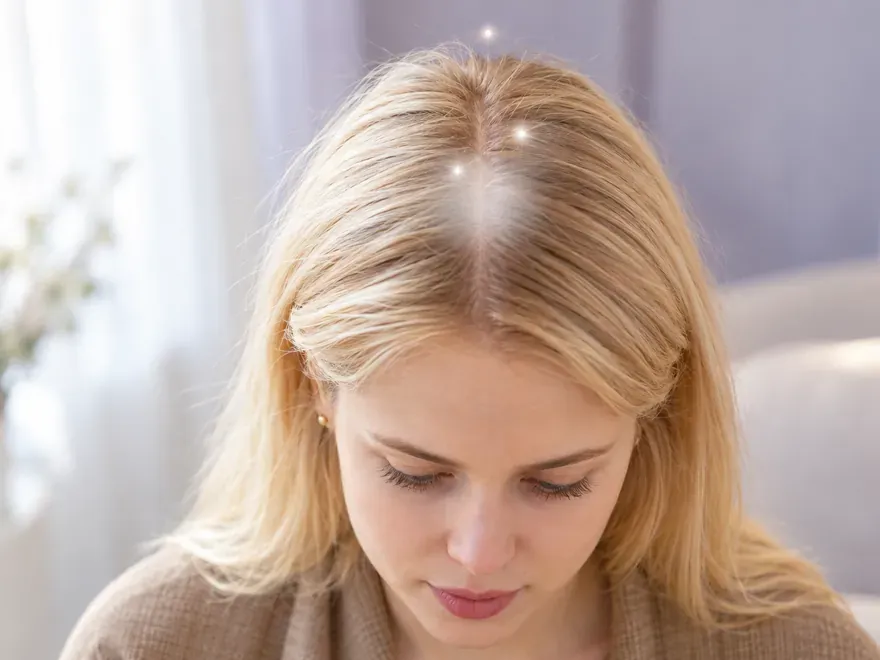
In women, this thinning follows a different distribution from that seen in men. Two typical patterns have been described in female-pattern hair loss: thinning that spreads outwards from the centre of the scalp, and thinning that is more marked towards the front, with the parting gradually widening. The front hairline is usually preserved.
A preserved front hairline is a distinguishing clue: in women, thinning is often noticed not as a receding hairline but as a widening parting. When the scalp is examined under magnification, the difference in thickness between hairs can also be seen.
The link with hormones is not as direct as people assume. Androgen levels are found to be abnormal in only one third of women with female-pattern androgenetic alopecia. According to expert consensus, when androgen levels are normal, this condition on its own should not be regarded as a sign of androgen excess; even so, assessment for androgen excess is considered necessary in every case.
The Two Conditions Can Occur Together
Telling telogen effluvium apart from androgenetic alopecia is not always easy. The two often occur together, and this overlap is one of the factors that make differential diagnosis, that is, reaching the right diagnosis among similar conditions, more difficult.
With long-lasting shedding, the picture becomes even more complicated. According to a review of the studies on this subject, a substantial proportion of cases diagnosed as chronic (long-term) telogen effluvium may in fact be early-stage female-pattern hair loss, or secondary telogen effluvium caused by something that has not yet been identified. The main limitation in this area is that there is no consensus even on the definition itself.
These studies also show what the distinction is based on: in all the studies in which a biopsy (a small tissue sample) was taken from people diagnosed with chronic telogen effluvium, the ratio of thick to fine hairs was found to be normal. In androgenetic alopecia, by contrast, this ratio is expected to shift towards fine hairs.
What this means in practice: when shedding has been going on for a long time, it would be premature to call it temporary or permanent straight away. The distinction is made by examining the scalp and the distribution of hair thickness, not by counting the hairs that fall out.
The concern itself should not be played down either. Research shows that hair loss carries a considerable psychological burden and can lead to anxiety and depression, and dismissing the concern is said to be one of the common mistakes doctors make. Reviews of long-lasting shedding also note that some people may in fact be focusing on normal shedding; but this can only be said once other causes have been ruled out, not at the outset.
What Is Checked at the Consultation
In female-pattern hair loss, assessment relies primarily on the clinical examination: the diagnosis is based on the patient's medical history and an examination of the scalp. Laboratory tests are used to support this clinical picture and to make sure that another underlying cause is not missed.
According to expert consensus, androgen excess should be assessed in all cases. Vitamin D, iron, zinc, thyroid hormone and prolactin measurements are among the recommended tests, but they are not mandatory.
It is important to read this distinction correctly. Checking a value does not mean that it is the cause of the hair loss; the aim is to make sure that a correctable deficiency or another disease is not missed. The results are also interpreted together with the examination findings, not one by one.
Another role of the examination is to identify scarring hair loss. In female-pattern hair loss, a scalp biopsy can be useful when the clinical assessment is inconclusive, or when scarring hair loss with a similar distribution is suspected. This distinction matters because in scarring hair loss the follicle is lost permanently.
How Much Iron, Thyroid and Vitamin D Can Explain
Ferritin is the marker of the body's iron stores. A low ferritin level is regarded as a sensitive and specific sign of iron deficiency; in other words, it picks up the deficiency well and is not easily confused with other conditions. It has also been found useful for ruling out iron deficiency in people who seek help for diffuse hair loss. However, ferritin is also an acute-phase reactant: when there is inflammation in the body, it can rise regardless of iron stores. This is why a ferritin result read on its own can be misleading.
A meta-analysis of studies looking at blood levels of trace elements in people with telogen effluvium found that ferritin and vitamin D levels were significantly lower than in the control group. It also showed marked differences between the results of the pooled studies. In other words, a link has been shown, but its strength varies from study to study.
On vitamin D, the data paint a more cautious picture. An inverse relationship has been reported between blood vitamin D levels and non-scarring hair loss. However, there is a lack of studies with clear results showing that vitamin D supplementation improves hair loss; for this reason, vitamin D cannot be recommended as a routine treatment.
The thyroid is a separate topic. Thyroid hormones regulate the growth, differentiation and metabolism of cells; both an overactive thyroid (hyperthyroidism) and an underactive thyroid (hypothyroidism) can cause diffuse hair loss. According to researchers who have studied the subject, the role of thyroid dysfunction in hair disorders is underestimated.
Hormonal Life Stages and the Biology of Stress
The hormonal background to hair loss is not limited to androgens. The oestrogen deficiency that develops naturally during the menopause transition can also cause hair loss. Thyroid hormones, for their part, have been linked to three of the most common types of hair loss.
The biology of strain, in other words stress, has also been studied in its own right: in stress-related hair loss, the focus is on the hormones of the hypothalamic–pituitary–adrenal axis, which controls the body's stress response. In short, behind the phrase “my hair fell out because of stress” lies a defined hormonal axis.
This does not justify putting all hair loss down to stress. Quite the opposite: because stress can cause hair loss through a defined mechanism, attributing hair loss directly to stress without looking into iron, thyroid function and hormones at all would be an incomplete assessment.
Limits of This Article
This article explains the mechanisms by which hair loss happens, not which one is at work in your case. The sentence “my hair is falling out” covers several quite different conditions, and what tells them apart is an examination of the scalp, not the number of hairs that fall out.
The second limit concerns scope. This article does not cover which medicine is suitable for whom, or below what threshold a laboratory value counts as a problem; both vary from person to person and are determined at a consultation, not by an article.
The vitamin lists and product recommendations circulating online make no such distinction; they apply one answer to every condition. Yet correcting a deficiency only makes sense if that deficiency really exists and has been confirmed by measurement.
What Is Offered for Hair Here
The clinic offers hair mesotherapy: superficial injections into the scalp with fine needles. Which condition this method may be considered for depends on how the distinction described above turns out at your consultation.
You should know clearly where the evidence for this method stands. In pattern hair loss, that is, the permanent thinning condition described above, studies of mesotherapy have reported positive results; however, these studies had too few participants, and studies comparing mesotherapy with other treatments are lacking. In short, more evidence is needed.
Who should not have the treatment, when it is postponed and how the sessions are scheduled are covered on the Hair Mesotherapy page; this is why no rates, durations or numbers of sessions are given here. A consultation shows which condition you have and whether hair mesotherapy has anything to offer for it; after that, the decision is yours.
References
- Integrative and Mechanistic Approach to the Hair Growth Cycle and Hair Loss · PMID 36769541
- Telogen Effluvium: A Review of the Literature · PMID 32607303
- Telogen effluvium: a comprehensive review · PMID 31686886
- COVID-19 infection is a major cause of acute telogen effluvium · PMID 34467470
- Post-COVID Telogen Effluvium · PMID 36919388
- Chronic Telogen Effluvium: Is it a Distinct Condition? A Systematic Review · PMID 37052778
- The Hormonal Background of Hair Loss in Non-Scarring Alopecias · PMID 38540126
- Female Androgenetic Alopecia: An Update on Diagnosis and Management · PMID 31677111
- Female Pattern Hair Loss and Androgen Excess: A Report From the Multidisciplinary Androgen Excess and PCOS Committee · PMID 30785992
- Serum Ferritin Levels: A Clinical Guide in Patients With Hair Loss · PMID 37820340
- Association between Serum Trace Elements and Telogen Effluvium: A Systematic Review and Meta-Analysis · PMID 42077991
- Role of vitamin D in hair loss: A short review · PMID 34553483
- Impact of Thyroid Dysfunction on Hair Disorders · PMID 37692605
- Current application of mesotherapy in pattern hair loss: A systematic review · PMID 35253335
The information on this page is for general information only and is not a substitute for medical advice. Your doctor assesses and advises; you make the decision. Last updated:
RELATED PAGES