THREAD LIFTING
Brow Thread Lift
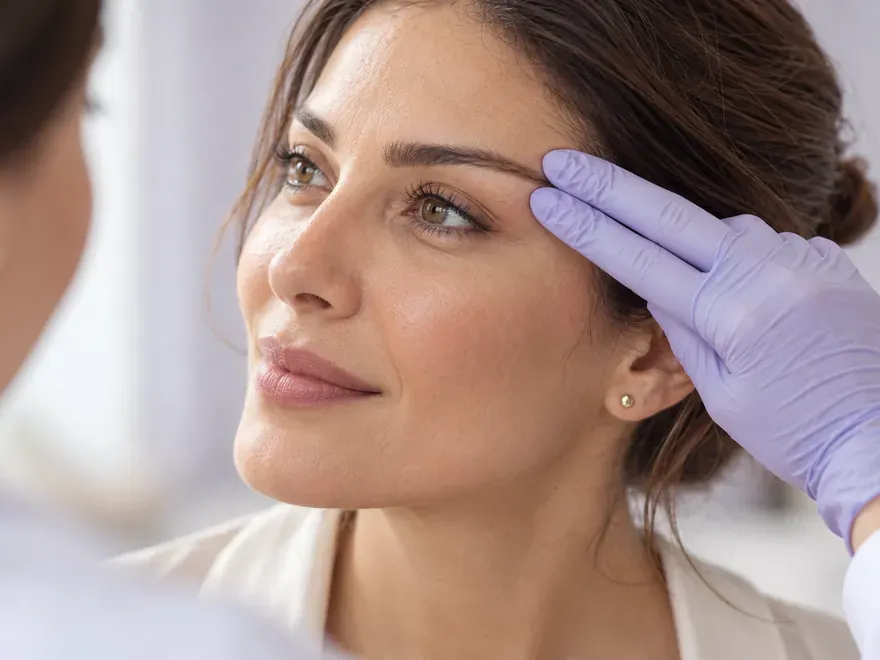
A brow thread lift gives the brow upward support using dissolvable, barbed medical threads placed under the skin of the forehead or temple. It is considered for mildly to moderately drooping brows. Its effect is more limited than surgery, and it does not remove excess skin from the upper eyelid.
- TREATMENT GROUP
- Thread Lifting
- TREATMENT AREAS
- Drooping BrowsTemples
- SCIENTIFIC REFERENCES
- 27 publications
APPOINTMENTS
Let’s talk at a consultation about whether Brow Thread Lift is right for you, what it involves and its possible risks.
Call usMessage us on WhatsApp+90 530 925 24 78
AT A GLANCE
At this clinic
- Product type
- Absorbable medical threads (PDO / PLLA, etc.)
- Sessions
- Usually 1 session
- Treatment time
- About 30–45 minutes
- How long it lasts
- Varies with the threads used, the treated area and individual factors; on average 3–4 years
- Anaesthetic
- Local anaesthetic
- Follow-up
- Usually after 2–4 weeks
The type of thread, the number of threads and the technique vary with the area treated.
What Is a Brow Thread Lift?
A brow thread lift gives the brow upward support by placing medical threads under the skin of the forehead or temple; the threads have small barbs on their surface that grip the tissue. It usually needs no surgical incision, and no skin is removed. The method is a thread lift adapted to the brow and forehead. The procedure is also called a “forehead thread lift”; however, because what it actually does is lift the brow, some authors consider “brow thread lift” the more accurate name.
The method is based on placing barbed threads along set lines to lift tissue that has descended. Its safety depends on a good knowledge of the blood vessels and muscles of the forehead and brow, and of the changes that come with age. According to a study of the anatomy of the brow area, placing I-shaped threads beneath the forehead muscle is a safer option than the traditional U-shaped placement.
According to a publication based on case reports, a brow thread lift is an intermediate step between surgical and non-surgical methods: it gives a subtler change than surgery, its effect fades over time, and it may need to be repeated.
RELATEDFillers or a Thread Lift?
When is it considered?
- A mildly to moderately low brow position.
- A heavy look to the upper eyelid caused by the position of the brow.
- Wanting to reshape and reposition the brow without any obvious droop.
- Age-related tissue laxity in the forehead and brow area.
- Situations in which a more limited effect than a surgical brow lift is acceptable.
- This list shows when the treatment may be considered; whether it is suitable for you is assessed at a consultation.
Has the Brow Really Dropped, or Has the Eyelid Become Heavy?
Your brow may look low, but that does not always mean it has dropped. Studies of how brow position changes with age have also produced results that differ from the common belief, and this difference directly affects which method is worth discussing.
An analysis pooling data from a total of 3,634 people in 19 studies found that, with age, the inner end and middle part of the brow rose, while the outer end, at the level of the outer corner of the eye, showed no significant change. In other words, on average the brow does not descend as a whole; different parts of the brow can change in different directions.
A study comparing 95 adults in three age groups also found no significant difference in brow height between the groups. The same study found that the forehead muscle worked more actively with age, and that excess skin on the upper eyelid (dermatochalasis) increased as brow height decreased. The researchers think that brow position is maintained by muscles working to balance one another.
What this means for you: the heaviness you see on your upper eyelid can come from the position of the brow or from excess eyelid skin; both can also be present in the same person. Drooping brows have also been reported to be common in people seeking eyelid surgery. Which one is dominant becomes clear at a consultation, not in the mirror.
RELATEDWhy does the face sag?
The Forehead Muscle and Brow Movement
The muscle that raises the brow is the forehead muscle (frontalis), and the part that actually moves the brow is its lower end. A brow thread lift is performed in the area where the forehead muscle meets the ring-shaped muscle around the eye.
According to an anatomical study combining cadaver, imaging and clinical observation data, the forehead muscle is firmly attached to the deep fascia (a thin sheet of connective tissue) in the upper and middle forehead. In the lower third, it separates from this layer and interlaces with the ring-shaped muscle around the eye (orbicularis oculi). In the same study, the brow rose only when this lower part of the muscle was pulled; the muscle moves the brow by contracting from its lower end towards its middle.
According to a review of the anatomy of brow thread lifting, it is important to know the nerve and blood vessel pathways in this area well, especially the supratrochlear and supraorbital vessels (vessels that run up into the forehead from the upper rim of the eye socket). Assessing how mobile the tissue is and how it is attached to the underlying structures before the procedure is also seen as key to predicting the result. The forehead has little subcutaneous fat (the fat layer under the skin), so the layer in which the thread is placed requires precise anatomical knowledge. In people whose tissue is firmly attached to the underlying structures, working through a partial tunnel made with a cannula (a fine, flexible tube with a blunt tip) has been reported. At the clinic, the doctor chooses a needle or a cannula for each person, based on the treatment area and their anatomy.
The Temple and the Temporal Branch of the Facial Nerve
The temple, which the threads can pass through in a brow thread lift, also contains the temporal branch of the facial nerve. This branch controls the forehead muscle. If it is damaged, problems that affect both function and appearance can occur, such as being unable to raise the brow.
The temporal branch controls many muscles of the upper face and is needed for facial expressions and for closing the eyelids. The path it takes varies from person to person. Some anatomical landmarks help to estimate where it lies, but they do not give an exact map.
A cadaver study found considerable variation in how this branch is distributed in the temple and concluded that there is no truly safe zone in the temple, only relatively safe zones. In another cadaver study, after crossing the arch of the cheekbone, the branch crossed the temple along a forward-curving line and reached the forehead muscle near the outer end of the brow.
Knowing the course of the facial nerve is necessary to reduce the risk of nerve damage, such as facial weakness or paralysis. This information does not show that the risk is common; it explains why the area requires detailed anatomical knowledge.
What Does the Research Say About Brow Thread Lifts?
Scientific evidence on brow thread lifts is still limited. Publications specific to the brow are based on small case series with no control group, case reports and reviews. Among the sources reviewed, there are no randomised trials (trials in which participants are randomly assigned to groups) comparing a brow thread lift with a control group or with another method.
In a series of 38 women reported from a single institution, a brow thread lift was performed in people with mild to moderate drooping brows or with no droop at all. On a scale based on patients’ own assessment (FACE-Q), brow and upper eyelid scores had improved from baseline at six months, and the significant increase was still present at 12 months. No serious complications were reported; the improvement was more marked in younger women. The participants’ average age was 35.5, and the study had no control group.
In another series of 15 people, the brows measured lower than at baseline one week after the procedure, while at 12 weeks the brow and upper eyelid were significantly higher than at baseline. This finding suggests that the early appearance may not reflect the result; however, this too is a small, uncontrolled series.
According to a publication based on case reports, a brow thread lift gives a subtler improvement than surgery, the procedure can be uncomfortable, the effect lasts about six months, and repeat treatment is needed as it fades. These differences between series do not show how long the effect can be expected to last for any one person.
The picture is similar for the face as a whole. A systematic review in this field found that in all but two of the studies examined, the lifting effect lasted a very limited time at most; the two studies reporting positive results were supported by thread manufacturers. A more recent review also stated that no new evidence supporting the method had been added.
SOURCEPMID 35441792PMID 37060183PMID 39135300PMID 29481392PMID 33471152
Limits of This Treatment
A brow thread lift is not a substitute for a surgical brow lift. It does not remove excess skin from the upper eyelid, and its effect is not permanent. These three limits define what you can expect from the treatment.
First, the scale of the effect is limited. The result is subtler than with surgery; the method is seen as an intermediate step between surgical and non-surgical treatments. According to a review of brow lift techniques, no brow lift method, surgical or non-surgical, is entirely satisfactory; the reasons are limited effect, limited longevity and possible complications.
Second, the duration is uncertain. It is not clear how effective techniques using dissolvable threads are in the long term. In an analysis pooling data from many studies of facial thread lifts (a meta-analysis), the satisfaction rate was 98% immediately after the procedure and 88% in the long term, and this difference is significant. The researchers recommend discussing before the procedure that the rejuvenating effect may not last in the long term.
Third, excess skin is a separate problem. Threads support tissue; they do not remove skin. If the heaviness you see comes from the skin of the upper eyelid, this is assessed separately in the relevant surgical specialty. These limits are not a reason to rule the treatment out; they show what you can expect. Your doctor assesses you; the decision is yours.
How It Differs from Botulinum Toxin for Brow Lifting
A brow lift with botulinum toxin uses no threads. The movement of the muscles that pull the brow down is temporarily reduced, and the position of the brow changes through the muscle balance. This treatment uses botulinum toxin, often called Botox®; that everyday name comes from the name of a product. It aims for a similar goal to a brow thread lift, but through a different mechanism.
A review of 11 studies and 585 patients that used objective measurements to examine botulinum toxin for brow shaping found the greatest lift in the outer part of the brow. It reported that different brow shapes can be achieved by targeting different muscle groups. The most commonly reported side effects were bruising and headache; a drooping eyelid (ptosis) occurred in five cases. The researchers nonetheless state that new randomised trials are needed.
This method has a subtlety of its own: because the forehead muscle is the muscle that raises the brow, treating this muscle can also lower the brow. In a randomised controlled trial in which the muscles that pull the brow down were also treated, the forehead muscle was injected in three different patterns. Two weeks later, the brow was lower at every measured point except its outer end, where it was higher; injections into the upper part of the forehead were found to reduce the risk of a drooping brow.
Put simply, threads mechanically lift the tissue that holds the brow, while botulinum toxin changes the balance of the muscles acting on the brow. According to a review of brow lift techniques, non-surgical methods are temporary, and correction is easier if a complication occurs. Whether one of the two methods, both together or neither will be considered is decided at a consultation.
How It Differs from a Surgical Brow Lift
A surgical brow lift is an operation in which incisions are made in the skin and the tissue is repositioned; it works on a different scale from a brow thread lift. Its assessment and the operation itself belong to the relevant surgical specialty; the information here is only to help you compare the two methods.
According to a review of brow lift techniques, surgical methods fall into three groups: those performed through an eyelid surgery incision, those performed directly above the brow, and those performed through the forehead or scalp. The most common method is the endoscopic forehead lift (performed through small incisions using a camera), but its longevity is also limited. A direct brow lift, on the other hand, is found useful in people who have facial weakness or paralysis and are more willing to accept scarring.
A meta-analysis of long-term results assessed 2,127 brows in 22 studies with an average follow-up of at least six months. In these data, with a weighted average follow-up of 20.9 months, the outer, middle and inner parts of the brow rose significantly. The researchers stated that these results support the long-term effectiveness and favourable safety profile of surgical brow lifts.
A review of 15 studies comparing open and endoscopic techniques found that endoscopic and less invasive techniques (those that disturb the tissue less) gave similar or better aesthetic results with a lower complication rate; however, differences between the studies limit the strength of this conclusion. Surgery has its own risks too: in direct brow operations performed through the temple, injury to the temporal branch of the facial nerve and the resulting brow paralysis are among the main complications described. The difference between threads and surgery is not one of degree; they are two separate methods that work on different scales.
Known Risks
There are no large-scale risk data specific to brow thread lifts; the rates below apply to all thread treatments of the face and neck. The most commonly reported effects are swelling, bruising and asymmetry (the two sides not looking the same). Dimpling, and threads that can be seen or felt, are among the findings that can persist beyond the first few weeks.
A meta-analysis covering 26 studies and 2,827 patients reported swelling in 34%, bruising in 26%, threads that could be seen or felt by hand in 10%, and skin dimpling in 7%. The researchers note that the variation between studies was very high, and that findings lasting beyond the first four weeks may be more clinically important.
In a review covering 14,222 patients, the most commonly reported finding was asymmetry, followed by swelling (oedema) and bruising. Serious side effects are rare; these are altered sensation, hair loss, and injury to blood vessels or glands. Another meta-analysis found that, with dissolvable threads, the risk of altered sensation and of the thread coming out through the skin was lower than with permanent threads, while in people over 50 the risk of dimpling and infection was higher. A review comparing dissolvable threads also reported that barbed threads were associated with more complications than smooth (non-barbed) threads.
Nerve injury is uncommon, but it is a recognised risk. In a series of 190 patients who presented with complications after thread treatments carried out elsewhere, five patients had partial facial paralysis; the researchers identified insufficient knowledge of the anatomy as the main cause. In the temple, isolated cases have been reported of an abnormal connection between the superficial temporal blood vessels (arteriovenous fistula) after a brow thread lift, and of a blood-filled sac (pseudoaneurysm) in the superficial temporal artery, caused by damage to the vessel wall, after a facial thread lift; both were noticed as a pulsating swelling.
Before the procedure, you will be asked about blood thinners, antiplatelet medicines (they stop blood platelets from clumping together) and supplements that can affect bleeding. Do not stop any prescribed medicine on your own. If needed, the procedure is planned or postponed after consulting the relevant doctor.
RELATEDWhat to look out for after a thread lift
SOURCEPMID 41988336PMID 34699439PMID 33821308PMID 39442180PMID 34549008PMID 37388255PMID 41468260PMID 39760325
Which Threads Are Used?
Threads used for lifting fall into two groups: dissolvable (absorbable) and permanent (non-absorbable). According to the sources, early treatments with permanent barbed threads had high rates of corrective procedures and complications. Techniques developed with dissolvable threads have shown fewer adverse effects; however, it is not clear how effective these techniques are in the long term. A meta-analysis also found that dissolvable threads carried a significantly lower risk of altered sensation and of the thread coming out through the skin than permanent threads, and recommended that permanent threads be used with caution.
At the clinic, dissolvable threads (PLLA/PDO, that is, poly-L-lactic acid and polydioxanone) are used. “Thread lift” is the general name for lifting treatments performed with threads; the French Thread Lift is one of the techniques within these methods. A brow thread lift is the treatment in this family designed for the brow and forehead.
When a dissolvable thread dissolves, this does not mean that the effect will end at that moment, nor that it will be permanent; data on this are limited. At the consultation, your doctor decides which thread to use, in which direction, and in which layer to place it.
RELATEDFrench Thread Lift
How the Decision Is Made
Deciding on a brow thread lift starts with putting the right name to what you see in the mirror: is your brow low, is your eyelid heavy, or is it both? Choosing a method before this question is answered can leave a gap between what you expect and the result.
At the consultation there is a clear order: first, what can be done is explained, then what cannot. Threads, botulinum toxin and surgery are not three different doses for the same problem; they are separate methods that work through different mechanisms. If one is not considered suitable, that does not mean another one is.
The information on this page is for general information only and does not replace a consultation. Your doctor assesses and advises; the decision is yours. This decision also includes choosing another approach or having no treatment at all. Writing down your questions before the consultation helps make sure none are missed.
THE CLINIC’S APPROACH
How Is Treatment Planned at This Clinic?
For a thread lift, the areas that need treatment are identified by assessing your facial anatomy, tissue structure and the direction of sagging. The thread technique, the number of threads and the directions of placement are planned individually for you; when needed, more than one area can be treated at the same time.
LIMITS
What this treatment
does not do
A brow thread lift gives the brow limited support and is not a substitute for a surgical brow lift. It does not remove excess skin from the upper eyelid; if the heaviness you see comes from the eyelid skin, threads do not solve this problem. Brow-specific data come from small, uncontrolled case series and case reports. How long the effect lasts is not yet clear, and it has been reported that repeat treatment may be needed. The brow moves through a balance between the forehead muscle and the muscles around the eye; results vary from person to person. These limits are not a reason to rule the treatment out; they show what you can expect. Your doctor assesses you; the decision is yours.
Who should not have this treatment?
Not suitable
- Pregnancy
- Active infection in the treatment area
- A serious skin problem in the treatment area
Needs a doctor’s assessment
- Bleeding or clotting disorders
- Taking blood thinners
- Immune system disorders
- Significant chronic illnesses
Whether you are suitable depends on your health and your tissue structure.
Aftercare
- Make-up is not recommended for the first 24 hours.
- For the first week, avoid strenuous exercise, saunas, steam rooms or hammams, intense heat, and massage or pressure on the treated area.
- Especially after a facial thread lift, for about 1 month, limit hard foods, excessive chewing and movements that require you to open your mouth very wide.
WHEN TO CONTACT US STRAIGHT AWAY
Contact the clinic if you notice pain, swelling or redness that is worse than expected or keeps increasing, or anything unusual. In a sudden, serious situation, such as difficulty breathing or a severe allergic reaction, call 112.
FAQs
Is a brow thread lift the same as a botulinum toxin brow lift?
No, they are different methods. In a brow thread lift, barbed threads placed under the skin mechanically lift the tissue that holds the brow. A botulinum toxin brow lift uses no threads; instead, the movement of the muscles that pull the brow down is temporarily reduced, and the position of the brow changes through the muscle balance. Botulinum toxin treatment has its own subtleties too: it has been reported that treating the forehead muscle can also lower the brow. Whether one of the two methods, both together or neither will be considered is decided at a consultation.How long does a brow thread lift last?
The scientific evidence does not yet give a clear answer to this question. Brow-specific data come from small, uncontrolled series. A publication based on case reports states that the effect lasts about six months and then needs to be repeated, while a series of 38 women reported that the improvement in patients’ self-rated scores was still present at 12 months. In reviews covering the face as a whole, too, the long-term effectiveness of dissolvable threads is not clear. These figures do not show how long the effect can be expected to last for you; you can ask your doctor at your consultation about the clinic’s own experience.Will a brow thread lift get rid of the heaviness in my eyelids?
It depends on where the heaviness comes from. Heaviness on the upper eyelid can come from a low brow position or from excess eyelid skin; both can also be present in the same person. Studies of brow position with age found that, on average, the outer end of the brow did not drop significantly, and that excess eyelid skin increased as brow height decreased. Threads support tissue; they do not remove excess skin. Which one is dominant becomes clear at a consultation.Can a brow thread lift damage the facial nerve?
Yes, it can. Nerve injury is infrequently reported after thread treatments, but it is a recognised risk. The temporal branch of the facial nerve controls the forehead muscle, which raises the brow; it passes through the temple, and its path varies from person to person. Cadaver studies have shown that there is no truly safe zone in the temple, only relatively safe zones. Partial facial paralysis has also been reported in a series of patients who presented with complications after thread treatments carried out elsewhere. This risk is one of the topics that should be discussed at the consultation before treatment.Will my brows look higher straight after the procedure?
Not always; how you look straight after the procedure may not fully reflect the result. In a series of 15 people, the brows measured lower than at baseline one week after the procedure, while at 12 weeks the brow and upper eyelid had risen significantly. Another publication based on case reports also describes the changes seen straight after the procedure separately from those that appear over time. These data come from small, uncontrolled series; what to expect in your own case is discussed at your consultation.Can the threads be seen or felt?
Yes, they can. A meta-analysis pooling studies of facial thread treatments reported threads that could be seen or felt by hand in 10% and skin dimpling in 7%. The researchers note that the variation between studies was very high, and that such findings lasting beyond the first four weeks may be more clinically important. These data apply to the face as a whole, not specifically to the brow. The forehead has little subcutaneous fat (the fat layer under the skin), which explains why the layer the thread is placed in is important.Does a brow thread lift replace a surgical brow lift?
No, it does not. According to the sources, a brow thread lift gives a subtler improvement than surgery, and its effect fades over time. A meta-analysis of the long-term results of surgical brow lifts, on the other hand, reported that the brow rose significantly and that the safety profile was favourable; however, surgery also has its own risks, such as scarring from incisions and nerve injury. The two are not a lighter and a heavier version of the same procedure; they are separate methods that work on different scales. Surgical assessment belongs to the relevant specialty.
References
- Anatomical perspectives of brow-lifting using threads: Clinical cases with techniques · PMID 39135300
- Anatomical considerations for thread-based brow lifting and wrinkle treatment · PMID 39884674
- Thread-Lifts: A Double-Edged Suture? A Comprehensive Review of the Literature · PMID 30893160
- Percutaneous Thread Lift Facial Rejuvenation: Literature Review and Evidence-Based Analysis · PMID 33471152
- Thread-Lift Sutures: Still in the Lift? A Systematic Review of the Literature · PMID 29481392
- Eyebrow lifting with barbed threads: A simple, safe, and effective ambulatory procedure · PMID 35441792
- Eyebrow lifting using multidirectional absorbable thread · PMID 37060183
- Eyebrow Height Changes with Aging: A Systematic Review and Meta-analysis · PMID 31942395
- Does the Eyebrow Sag with Aging? An Anthopometric Study of 95 Caucasians from 20 to 79 Years of Age · PMID 26818320
- The Anatomy of the Frontalis Muscle Revisited: A Detailed Anatomic, Clinical, and Physiologic Study · PMID 37768166
- A Deeper Dive into the Anatomy of the Frontal Branch of the Facial Nerve · PMID 40268626
- The frontal branch of the facial nerve: can we define a safety zone? · PMID 25342224
- Topography of the frontal branch of the facial nerve and its clinical implication for temporal direct browplasty · PMID 37652939
- Anatomical Considerations for Thread Lifting Procedure · PMID 39376117
- Techniques of Eyebrow Lifting: A Narrative Review · PMID 32308957
- A Meta-Analysis and Systematic Review of the Incidences of Complications Following Facial Thread-Lifting · PMID 33821308
- Botulinum Toxin for Eyebrow Shaping: A Systematic Review · PMID 33065951
- The Impact of Upper Face Botulinum Toxin Injections on Eyebrow Height and Forehead Lines: A Randomized Controlled Trial and an Algorithmic Approach to Forehead Injection · PMID 30102667
- Long-Term Brow Lift Outcomes: A Systematic Review and Meta-Analysis · PMID 40788666
- Comparative Outcomes of Traditional Versus Endoscopic Brow Lift Techniques: A Systematic Review · PMID 41710188
- A meta-analysis of complications of thread lifting · PMID 41988336
- Safety Profile of Thread Lifts on the Face and Neck: An Evidence-Based Systematic Review · PMID 34699439
- An Assessment and Comparison of Adverse Effect Rates in Differing Absorbable Thread Lift Suture Materials · PMID 39442180
- Facial Thread Lifting Complications in China: Analysis and Treatment · PMID 34549008
- AVF of superficial temporal vessels after thread brow lift, report of a case · PMID 37388255
- Superficial Temporal Artery Pseudoaneurysm Following Facial Thread-Lift: A Rare Complication · PMID 41468260
- Facial Thread Lifting Complications · PMID 39760325
The information on this page is for general information only and is not a substitute for medical advice. Diagnosis and treatment require an assessment by a doctor. Last updated:
Read more





FIRST CONSULTATION
Is Brow Thread Lift right for you? Let’s talk it through together.
A first consultation is not a treatment appointment. Your concern is assessed and the options and their limits are discussed; deciding not to go ahead is also a decision.