DERMAL FILLERS
Buttock Filler
Buttock filler, also known in everyday language as ‘bum filler’, means injecting a hyaluronic acid filler suitable for use on the body into the tissue under the skin, to address a need for volume and contour (outline) in the buttocks. It is not permanent and is not a substitute for surgical buttock augmentation.
- TREATMENT GROUP
- Dermal Fillers
- TREATMENT AREAS
- Hip dipsHips and surrounding areas
- SCIENTIFIC REFERENCES
- 14 publications
APPOINTMENTS
Let’s talk at a consultation about whether Buttock Filler is right for you, what it involves and its possible risks.
Call usMessage us on WhatsApp+90 530 925 24 78
AT A GLANCE
At this clinic
- Product type
- Hyaluronic acid (HA) filler for the body
- Sessions
- Usually one session; further sessions may be planned depending on your needs and the volume aimed for
- Treatment time
- About 30–60 minutes, depending on the amount of filler
- How long it lasts
- 18–24 months on average
- Anaesthetic
- Local anaesthetic to the treatment area
- Follow-up
- Within 2–4 weeks
What is buttock filler?
Buttock filler, also known in everyday language as ‘bum filler’, means injecting a filler into the tissue under the skin to add volume and contour to the buttocks. It is one of the ways of adding volume to and shaping the buttocks without surgery, and the number of studies published on the subject is reported to have risen quickly in recent years.
The treatment has two separate goals that should not be confused. The first is volume: how full the buttocks are and how far they project backwards (projection). The second is contour: the outline of the buttocks as seen from behind and from the side, in other words where the line changes direction and where it flattens. Studies also treat the buttocks not as a single target but as areas that are planned separately; one study assessed the region by dividing it into four quadrants, and another by dividing it into three separate areas.
For any one person, only one of these goals may apply, both may apply, or neither. Which applies to you becomes clear at the consultation.
Buttock filler is not the same as buttock augmentation surgery
In everyday language, ‘buttock enlargement’ is talked about as if it were a single procedure. In fact there are three separate methods, and each has a different scope, risk profile and scientific basis.
- Filler injection (buttock filler): a filler is placed in the tissue under the skin; it is not an operation and usually does not need a surgical incision or stitches.
- Fat injection (commonly known as a BBL): a surgical procedure in which some of the person’s own fat tissue is removed and transferred to the buttocks.
- Implant: a surgical procedure in which a prosthesis is placed in the buttocks.
Buttock filler is only the first of these three methods; the other two are separate, surgical procedures. This distinction matters not to set one method against another, but to keep the terms from being confused: someone looking for information on buttock filler often also lands on pages describing surgical procedures and assumes the results of two different procedures are the same.
There is one more thing to know about fat injection. In a review comparing cosmetic fat transfer procedures, fat transfer to the buttocks was associated with a markedly higher death rate than fat transfer to the face or the breasts. This was attributed to a combination of the large veins inside the buttock muscles, the injection technique and the amount of fat transferred. The measures highlighted to reduce the risk include injecting the fat under the skin rather than into the muscle, and using ultrasound. However, studies in this field do not report complications in a standard way, and this is a limitation of the available data. The aim of this information is not to put you off a surgical method, but to show that the two procedures are not the same decision.
When is it considered?
Buttock filler may be considered in the situations below. However, having one of these does not mean the treatment is suitable for you; suitability is assessed separately at a consultation.
- Volume loss in the buttocks, or buttocks that appear to lack volume.
- A less defined outline (contour) of the buttocks, as seen from behind and from the side.
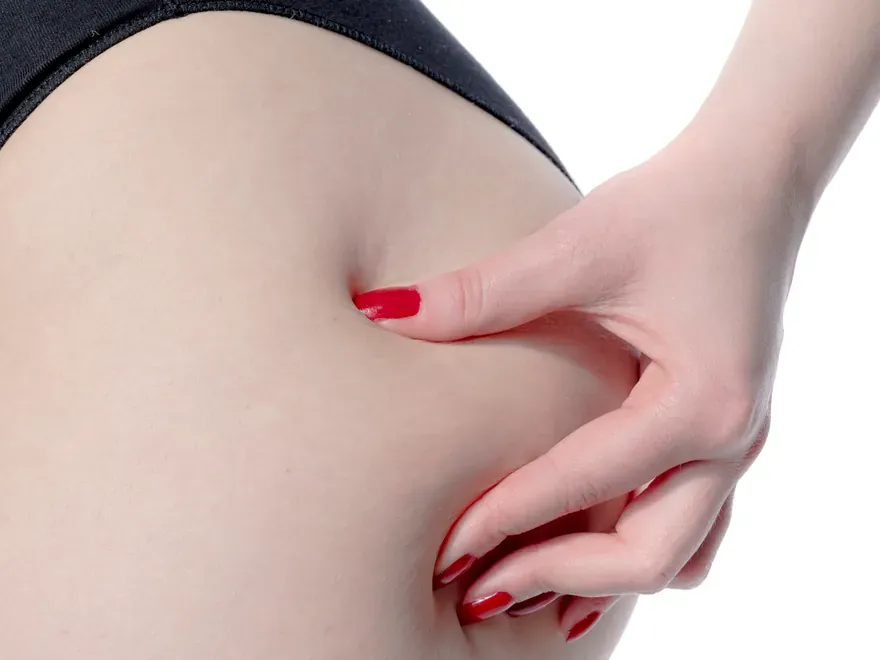
- An indented look at the side of the hips (trochanteric depressions, known in everyday language as hip dips); this is not a disease.
- An asymmetrical look between the right and left sides.
- Changes in the skin and soft tissue of the area that come with age.
- Plans in which skin quality, contour and volume are each targeted separately; a publication describing the use of collagen-stimulating fillers in the buttocks treats these three goals separately.
What are hip dips and what causes them?
Hip dips is the everyday name for an inward dip on the upper outer side of the hip area, between the pelvis and the large bony prominence at the top of the thigh bone. The medical term is prominent trochanteric depressions; the name comes from the bony prominence on the upper outer part of the thigh bone (the greater trochanter).
According to the publication on this subject, this dip may be linked to two things: muscle definition developed through sport, and ageing. In other words, hip dips are described not as a line that never changes, but as a feature whose prominence can change over time. Beneath the dip lies the relationship between the bone structure of the area and the muscle and fat tissue over it; this is an assessment based on the anatomy of the area, not the finding of a single study.
In a study that mapped the buttock region with ultrasound, the buttocks were divided into four quadrants for systematic examination; the lower back, the back of the thigh, the trochanteric depression and the groin were also included separately. The fact that the trochanteric depression was named as a separate region in this examination shows that scientific studies define this area in its own right.
Hip dips are not a disease
Hip dips has become a much-searched term in recent years; however, it is an anatomical feature, not a diagnosis.
Scientific publications do not describe hip dips as a disease, a disorder or a diagnosis. The publication on this subject treats them as an aesthetic contour (outline) issue and states that their prominence may be linked to muscle development or ageing.
The following two points are based not on a scientific source but on what is said at the consultation: this dip is present in people to different degrees, and its being prominent does not, on its own, mean that something needs to be done.
The fact that a filler treatment has been described for this area does not change this picture. The publication on this subject describes a technique in which a hyaluronic acid product with large molecules that resists changing shape (with a high G' value) was injected into the intermediate layer under the skin in eleven female patients with moderate to severe trochanteric depressions. However, this is a technique described in a single series of only eleven people; it is not a general criterion showing who it is suitable for.
Deciding to have no treatment at all after reading this information is also a valid outcome.
SOURCEPMID 39624740
Hips, legs and surrounding areas
The buttocks are not assessed in isolation from the areas around them. In the study that mapped the region with ultrasound, the lower back, the back of the thigh, the trochanteric depression and the groin were also treated as part of the same examination as the buttocks. In other words, these areas lie along the same line; a change in volume or contour in one also affects how the neighbouring area looks.
The area commonly called the hips is also part of this neighbourhood and is often mentioned together with the buttocks. However, the hips and the buttocks are not the same concern: one is about width, the other about volume and contour. One may need added volume, the other a more defined outline. Whether your concern relates to one or the other, or whether both should be assessed together, becomes clear at the consultation.
You can find filler treatments for areas of the body other than the buttocks on the Body Fillers page.
SOURCEPMID 41097881
Limits of this treatment
The scientific data set out the limits of buttock filler as follows:
- Filler is not a substitute for surgical buttock augmentation methods. The amounts of filler given by injection cannot match the level of volume achieved with fat injection and implants.
- If there is advanced skin laxity (loose skin), filler does not tighten the skin.
- The bone structure beneath the buttocks and the width of the pelvis do not change; filler does not remove the bony relationship beneath hip dips. What can be changed is the soft-tissue outline over it.
- Widespread volume loss caused by significant weight change cannot be fully restored by treating a single area.
- The filler types described for this area (hyaluronic acid and collagen stimulators) are not permanent; they break down in the tissue and their effects wear off. In a one-year follow-up study, the fall in satisfaction over time was explained directly by this breakdown.
- Cellulite (dimpled, ‘orange-peel’ skin) is a separate issue; it is not the same thing as a treatment aimed at buttock volume.
The aim of these points is not to steer you in one direction, but to give you a basis for comparison. Knowing what a treatment can do is incomplete without knowing what it cannot do.
THE CLINIC’S APPROACH
How is treatment planned at this clinic?
At the clinic, hyaluronic acid (HA) fillers suitable for use on the body are used to shape the buttocks.
The treatment is mainly carried out with a cannula (a fine, flexible tube with a blunt tip). The treatment area and tissue plane are decided according to each person’s anatomy.
Hip dips are assessed together with the buttocks as a whole and with your body proportions. In suitable patients, the hip dip area alone can also be treated; however, the areas needed for a balanced transition and the amount of filler are planned individually.
If the contents of a product previously injected into the buttock area are not known, or if there is a history of permanent filler, biopolymer or liquid silicone, a new filler treatment is not routinely planned straight away. First, the previous product and the condition of the area are assessed; if necessary, imaging or an assessment by the relevant specialist is requested. Suitability is decided by the doctor.
The hyaluronic acid fillers used can be dissolved with hyaluronidase if necessary; however, because of the amount injected and the characteristics of the area, this process is assessed individually. Patients are given this information before the procedure.
Blood thinners, antiplatelet medicines and supplements that can affect bleeding are always asked about before the procedure. Do not stop any prescribed medicine on your own. If needed, the procedure is planned or postponed after consulting the relevant doctor. Patients are told that there may be an increased risk of bruising and bleeding.
Possible side effects and complications
A review bringing together studies on hyaluronic acid treatments in the buttocks reported the following mild effects: bruising and redness, fluid collection and an inflammatory reaction at the injection site, filler migration, and contour irregularity (uneven contours). Although the complication rate was limited, serious complications have also been reported; these include widespread bleeding into the air sacs of the lungs (diffuse alveolar haemorrhage) and death.
Two more recent studies give a more positive picture. A multicentre study that retrospectively reviewed the records of 91 people reported no serious side effects; most of the effects seen appeared shortly after treatment and resolved within one week. This study makes another important point: side effects were more common in people who had previously had other substances injected into the same area. The study that followed 30 women for one year also reported no serious side effects, and mild complications were rare.
In short, most of the reported effects are mild and temporary; however, serious complications have also been reported and cannot be ignored. The numbers of patients in these studies are small and none of them are data from this clinic; for this reason, no rate is given here.
Who performs the treatment also matters. A study reviewing five years of records of 58 patients admitted to hospital because of filler complications reported cellulitis (an infection of the skin and the tissue beneath it), abscess, granulomatous inflammation (chronic inflammation that forms small lumps) and tissue death (necrosis); it noted that severe complications were more common after injections given by people without medical authorisation. The study also stressed that patients noticing the early signs of a complication changed the outcome. This study covers all areas of the body, not only the buttocks.
These risks must be explained to you before the treatment.
Which classes of filler have been described?
As required by regulation, product brands are not named here: Türkiye’s Regulation on Promotion and Information Activities in Health Services (Official Gazette, 12 November 2025, No. 33075, Article 5(1)(h)) does not allow the promotion of product and device brands. For this reason, only filler classes are mentioned.
Two different approaches have been described for the buttock area:
Hyaluronic acid fillers. Treatments with cross-linked products (whose molecules are bonded to one another) have been described in this area. The publication describing the technique for trochanteric depressions (hip dips) states that the chosen product resists changing shape because of its high G' value and large molecular structure. The key feature of this class is that it is not permanent and breaks down in the tissue over time. In a one-year study, ultrasound showed that the filler settled under the skin, was gradually absorbed and integrated with the tissue, and showed no signs of migration, hardening (fibrosis) or lumps (nodules). On the other hand, publications on this subject state clearly that current practice for hyaluronic acid in the buttocks has not yet become standardised.
Collagen-stimulating classes. The use in the buttocks of substances that stimulate the tissue to produce collagen, such as poly-L-lactic acid (PLLA), has also been described. In this class, the volume comes not directly from the substance itself but from the tissue’s response. The publication in question explicitly describes this use as off-label, that is, use outside the product’s approved uses. The results for this technique are based on subjective clinical observations; no patient satisfaction or safety data were reported.
Before treatment, you should ask which class of filler will be used, whether it can be reversed, how long it stays in the tissue and what it is registered for in Türkiye. Which class is preferred in which situation at the clinic depends on the doctor’s assessment.
SOURCEPMID 41423732PMID 41282456PMID 39624740PMID 37361362Resmî Gazete, 12.11.2025 / 33075
Amount used and how long the effect lasts: why don’t the figures in studies agree?
‘How many cc are used?’ and ‘How long does it last?’ are the two questions asked most often about buttock filler. Before turning to the figures reported in studies, it is important to know this: these figures are not a recommendation, a standard or data from this clinic.
Amount. In a systematic review bringing together ten studies and 168 patients, the mean amount of hyaluronic acid reported for the intended result was 206.71 mL. This is not an unconditional average, but the average the studies reported for the result each of them was aiming for. By contrast, in the study that followed 30 women for one year, the mean amount was 43.60 mL, with an upper limit of 60 mL per person. In another study assessing 26 women, the mean was 40.4 mL, with an upper limit of 100 mL; this study states clearly that it describes a technique aiming to achieve a result with the smallest possible amount. The difference is close to fivefold. This is because the studies were done with different products, different techniques and different goals. So a cc figure you read online does not tell you how much will be used for you.
Duration. The same review reported that the product’s effect lasted an estimated 16.16 months. In the one-year follow-up study, patient satisfaction was at its highest on day 30 and had fallen markedly by month 12; this fall was explained by the hyaluronic acid breaking down in the tissue.
When weighing up these figures, you also need to know the level of evidence: the review rates its own level of evidence as III, and the other two studies were carried out with small groups of patients and different products. Figures like these do not predict how long the effect will last in any one person. The amount used for you and the expected duration depend on the assessment at your consultation.
Anatomy of the area and imaging
Among the areas treated with filler, the buttocks need particular care. A review that used cadaver studies to examine fat and filler embolisms after cosmetic injections (where material enters a blood vessel and blocks it) listed the high-risk areas as the temples, the area around the eyes, the nose and the buttocks. The deep blood vessels of the buttocks were described as the main route for embolism. It was noted that even small amounts can cause serious complications; approaches that reduce the risk include injecting at low pressure and using a cannula (a fine, flexible tube with a blunt tip). These findings also have a limitation: conditions in a cadaver differ from living tissue, and the injection techniques used in the studies reviewed differ from one another.
Ultrasound assessment of the area is a separate topic. A study of 110 patients described the ultrasound anatomy of the buttocks and mapped how different filler substances look in the tissue. According to this study, ultrasound is useful for two things: telling which substance is present in the tissue and spotting complications early. This is especially important for people who have previously had a treatment elsewhere with a substance of unknown type.
The aim of this information is not to put you off a treatment, but to show clearly why this area needs care.
Permanent substances and unlicensed treatments
There is something else to know about the buttock area: permanent synthetic substances (biopolymers, liquid silicone and similar) being injected into this area. These substances are not the same as hyaluronic acid or collagen-stimulating fillers. Buttock filler as described here covers classes of filler that the body can absorb.
In a series that examined the tissue of 20 patients who had permanent substances removed from the buttock and lower back area, long-term (chronic) inflammation and a foreign body reaction were seen; in some of the patients, raised blood levels of calcium, lactate dehydrogenase and parathyroid hormone were reported. Removing these substances is itself a surgical procedure: in a series of 35 patients treated with open surgery, the most common complication was seroma (a build-up of fluid at the wound site), followed by wound breakdown and infection. The procedure was completed without complications in fewer than half of the patients.
Injecting a permanent substance into the tissue is a decision that cannot be undone, and its consequences can appear years later. For this reason, it is worth asking before treatment about the class of substance to be used, whether it is permanent and its registration status.
Regulatory status
For buttock treatments at the clinic, hyaluronic acid (HA) fillers suitable for use on the body are used. For the products used at the clinic, the basis is the product’s CE marking, its registration and conformity status in Türkiye, and the manufacturer’s intended purpose and indications (approved uses). Approval by the US Food and Drug Administration (FDA), the US regulator, is not on its own a criterion for assessment. Products used on the body are assessed product by product and indication by indication.
If you are curious about what another country’s regulator says: on its consumer information page, the FDA states that it does not recommend using fillers for body shaping (contouring) or adding volume, and it does not list increasing buttock volume among their approved uses. The situation is similar for collagen-stimulating classes: the publication describing the use of poly-L-lactic acid in the buttocks describes this use as off-label (outside the uses covered by the product’s licence or approval).
This information is one country’s regulator explaining its own product approvals. On its own, it does not determine whether a product is safe or suitable; the scope of approval varies from country to country and from product to product. Before treatment, you can ask which class the product to be used for you belongs to and what it is registered for.
SOURCEFDAPMID 37361362
How the decision is made
At your consultation, the order is clear: first what can be done, then what cannot. If the second is skipped, the first is incomplete.
The buttocks are not an area where a single treatment answers every question. Behind what looks like a single concern in the mirror there may be volume, contour, skin laxity or the bone structure itself. These are not all addressed with the same method, and for some of them nothing can be done. If a decision is made before it is clear which one predominates, expectations and results often do not match.
One thing needs to be underlined: none of the conditions mentioned here, including hip dips, is a flaw that needs correcting. Wanting a treatment and not wanting one are both legitimate. The aim is not to recommend one choice over the other, but to help you make your decision based on information.
What is written here is general information and is not a substitute for a consultation. Your doctor assesses and advises; the decision is yours. This decision also includes choosing another approach or having no treatment at all.
LIMITS
What this treatment
does not do
Buttock filler is not a substitute for surgical buttock augmentation methods (fat injection or implants) and does not achieve the level of volume these methods provide. It does not tighten advanced skin laxity (loose skin), does not fully restore widespread volume loss caused by weight change and does not change the bone structure beneath the buttocks. The filler types described for this area (hyaluronic acid and collagen stimulators) are not permanent; they break down in the tissue over time and their effects wear off. Serious complications have been reported because of the blood vessels in this area (source: PMID 37407710 · PMID 41631193); who can have the treatment is decided only at a consultation.
Who should not have this treatment?
Not suitable
- Pregnancy and breastfeeding
- An active infection in the treatment area
- A known allergy to the product to be used
Needs a doctor’s assessment
- Bleeding or clotting disorders
- Autoimmune or systemic diseases
- Old fillers, or fillers of unknown type, previously injected into the area
Age limit
18 years and over. Special cases under 18 where there is a medical need are considered separately, with a doctor’s assessment and the consent of a legal representative.
Aftercare
- For 1 week after treatment, avoid strenuous exercise and intense sport.
- In the first few days, firm pressure on the area and massage are not recommended.
- Avoid saunas, steam rooms or hammams, and extreme heat.
- Keep the injection points dry and clean for the first 3–4 days.
- The follow-up appointment takes place within 2–4 weeks.
WHEN TO CONTACT US STRAIGHT AWAY
Contact the clinic straight away if you have severe or increasing pain, marked redness or warmth, excessive swelling, a change in skin colour, discharge or a fever.
FAQs
What is buttock filler and how is it done?
Buttock filler (often called ‘bum filler’) means injecting a filler into the tissue under the skin to address a need for volume and contour (outline) in the buttocks; it is not an operation and usually does not need a surgical incision or stitches. Studies treat the buttocks not as a single target but as areas that are planned separately; the region has been assessed by dividing it into four quadrants or into three separate areas (PMID 41423732 · PMID 41282456). Which area is treated, in which tissue layer and with how much filler depends on each person’s anatomy and is decided at the consultation.Is ‘bum filler’ the same as buttock filler?
Yes, they are the same treatment. ‘Bum filler’ is the name used in everyday speech, while ‘buttock filler’ is used more in writing; there is no clinical difference between them.How much does non-surgical buttock filler cost?
No prices are given here, because the promotion of and information on health services may not include prices, discounts, special offers or promotions (Türkiye’s Regulation on Promotion and Information Activities in Health Services, Official Gazette, 12 November 2025, No. 33075). In addition, the scope of the treatment varies from person to person: which area is treated, with what plan and with which class of filler only becomes clear after a consultation.Is buttock filler permanent, and how long does it last?
No, it is not permanent: hyaluronic acid and collagen-stimulating fillers break down in the tissue over time and their effects wear off. The data on how long the effect lasts do not fully agree. A systematic review bringing together ten studies and 168 patients, which rates its own level of evidence as III, reported that the product’s effect lasted an estimated 16.16 months (PMID 37407710). In a study that followed 30 women for one year, satisfaction was at its highest on day 30 and had fallen markedly by month 12, and this fall was explained by the filler breaking down in the tissue (PMID 41423732). These figures come from small groups of patients and different products; they do not predict how long the effect will last for you, and they are not this clinic’s observations. Injecting permanent synthetic substances such as biopolymers or liquid silicone into this area is a separate matter and is covered in the Permanent substances and unlicensed treatments section.How many cc of buttock filler are used?
There is no standard amount; the amounts reported in studies vary widely. In a systematic review, the mean amount of hyaluronic acid reported for the intended result was 206.71 mL (PMID 37407710). In a study that followed 30 women for one year, the mean was 43.60 mL, with an upper limit of 60 mL per person (PMID 41423732). In another study assessing 26 women, the mean was 40.4 mL, with an upper limit of 100 mL; this study states clearly that it describes a technique aiming to achieve a result with the smallest possible amount (PMID 41282456). The difference is close to fivefold and comes from different products and different goals. The amount used for you depends not on these figures but on the assessment at your consultation.What are hip dips and what causes them?
Hip dips is the everyday name for an inward dip on the upper outer side of the hip area. The medical term is prominent trochanteric depressions; the name comes from the bony prominence on the upper outer part of the thigh bone. Scientific publications do not describe hip dips as a disease, a disorder or a diagnosis; the publication on this subject treats them as an aesthetic contour issue and states that their prominence may be linked to muscle definition developed through sport or to ageing (PMID 39624740). Their being prominent does not, on its own, mean that something needs to be done.Can exercise get rid of hip dips?
Exercise does not always reduce hip dips. Beneath hip dips lies a line formed by the bone structure of the area and the muscle and fat tissue over it; the bone structure changes neither with exercise nor with filler, and what can change is the soft tissue over it. Moreover, it has been noted that this dip may be linked to muscle definition developed through sport. A filler treatment has been described for this area, but the published series is small: the technique was described in eleven female patients with moderate to severe depressions (PMID 39624740). What your situation is, and whether anything should be done, is assessed at the consultation.Can a buttock lift be done with filler?
It depends on what predominates in your case: filler works on volume and contour; if there is advanced skin laxity (loose skin), it does not tighten the skin. In everyday language, ‘buttock lift’ is a phrase that covers more than one procedure, and they are not all the same thing. Surgical options have been described for cases where skin laxity predominates; these are different procedures from filler treatment. Whether volume, contour or skin laxity predominates in your case is determined at the consultation.Is the hip area treated as well?
Whether the hips are assessed, and whether they are considered together with the buttocks, is decided at the consultation. The hips and the buttocks are neighbouring areas and are often mentioned together, but they are not the same concern: one is about width, the other about volume and contour. In the study that mapped the buttock region with ultrasound, the lower back, the back of the thigh, the trochanteric depression and the groin were also treated as part of the same examination as the buttocks (PMID 41097881); in other words, a change in one area also affects how the neighbouring area looks. Treatments for areas of the body other than the buttocks are described on the Body Fillers page.
References
- Effectiveness and Role of Using Hyaluronic Acid Injections for Gluteal Augmentation: A Comprehensive Systematic Review of Techniques and Outcomes · PMID 37407710
- Assessment of Hyaluronic Acid Filler in Gluteal Augmentation and Contouring: A 1-Year Prospective Study · PMID 41423732
- Hyaluronic Acid Gluteal Augmentation: New Marking and Application Technique · PMID 41282456
- Nonsurgical Gluteal Volume Correction with Hyaluronic Acid: A Retrospective Study to Assess Long-term Safety and Efficacy · PMID 38726041
- Hip dips technique: Filling lateral depressions with hyaluronic acid of large particles · PMID 39624740
- Reviewing the Ultrasound Anatomy of the Gluteal Region and the Mapping of Fillers · PMID 41097881
- Mechanisms of fat and soft tissue filler embolism following aesthetic injections: A cadaveric systematic review · PMID 41631193
- Fatal fat embolism in cosmetic surgery: Comparing gluteal fat grafting to other lipofilling procedures · PMID 42571244
- Biopolymers: Histopathologic Case Series of Patients with Permanent Synthetic Fillers Presenting Chronic Granulomatous Reaction and Hypercalcemia · PMID 39410973
- Paramedian open approach for gluteal biopolymers removal: a case series of 35 patients · PMID 40837208
- Analysis of Hospitalization Cases for Filler Injection Complications: A Five-Year Retrospective Study Among Iranian People · PMID 39681832
- Targeted and Individualized Gluteal Poly-L-Lactic Acid Injection for Optimal Aesthetic Results in the Gluteal Region · PMID 37361362
- Dermal Fillers (Soft Tissue Fillers) · FDA
- Sağlık Hizmetlerinde Tanıtım ve Bilgilendirme Faaliyetleri Hakkında Yönetmelik · Resmî Gazete, 12.11.2025 / 33075
The information on this page is for general information only and is not a substitute for medical advice. Diagnosis and treatment require an assessment by a doctor. Last updated:
Read more




FURTHER READING


FIRST CONSULTATION
Is Buttock Filler right for you? Let’s talk it through together.
A first consultation is not a treatment appointment. Your concern is assessed and the options and their limits are discussed; deciding not to go ahead is also a decision.